

Robot Listing Practice: Explain Ties in the Review Order
2026-11-03
Robot Listing Practice: Explain Ties in the Review Order
A marketplace reviewer returns to a list and finds that two robot records have exchanged positions, although their displayed sort values look identical. Before interpreting the movement as a change in seller activity, inspect the ordering rule. A review order is a software arrangement of selected records; it is not automatically a quality ranking. This exercise defines a reproducible order on an authorized data copy without examining actual marketplace listings.
Define the selected records before defining their order
Record the dataset copy, filters and review purpose. A changed selection can alter positions even when the ordering expression is identical. If a live list is changing, preserve an appropriate snapshot or otherwise document the observation scope. Do not claim that an ordering rule alone freezes the underlying records.
Write down what the requested sort is intended to help the reviewer do. Alphabetical browsing, review scheduling and a claimed ranking are different purposes. The meaning of a displayed position should be explained independently of the query that produces it. A convenient first row should not quietly become the recommended purchase.
Inspect the complete ordering expression
The SQLite SELECT documentation explains ordering by multiple expressions and states that rows equal on all ORDER BY expressions have undefined relative order. Retain the whole expression, including direction and any secondary keys. A display showing only the first sort field may conceal the conditions that determine record positions.
On the working copy, identify groups whose ordering values are equal under the applicable comparisons. Preserve their record identifiers and the fields used for sorting. This is a review of the order definition, not a reason to alter seller data or give one record a fabricated value so it appears first.

Choose a final key that fits the record model
If the review requires a fully specified order, ask the data owner which stable, unique record identifier can serve as a final ordering key. The identifier should belong to the selected record model, rather than being improvised from a displayed title that may repeat or change. Document the decision with the review purpose.
A unique final key can clarify relative order within a fixed selection, but it does not make different snapshots identical. New records, revised fields and changed filters still need their own explanations. Keep the intended repeatability claim narrow enough for another reviewer to reproduce from the stated copy and query.
Retain comparison rules for text fields
The SQLite datatype and collation documentation describes collation rules used for text comparisons. A text ordering note should identify the applicable collation rather than assuming every tool treats case and character sequences identically. The existence of a sort clause does not specify every editorial expectation about human names or model labels.
Where the list's intended language or naming convention requires a particular comparison, ask the owner to document it. Do not silently normalize identifiers, discard characters or convert text to numbers to obtain a preferred order. The original record and the chosen comparison rule should remain independently inspectable.
If the review tool displays formatted values, retain the underlying sort fields as permitted by the data policy. Two labels that appear equal after formatting may differ in the stored representation. Conversely, records that look distinct can compare equally under the chosen rule. The investigation needs the relevant representation and comparison context.
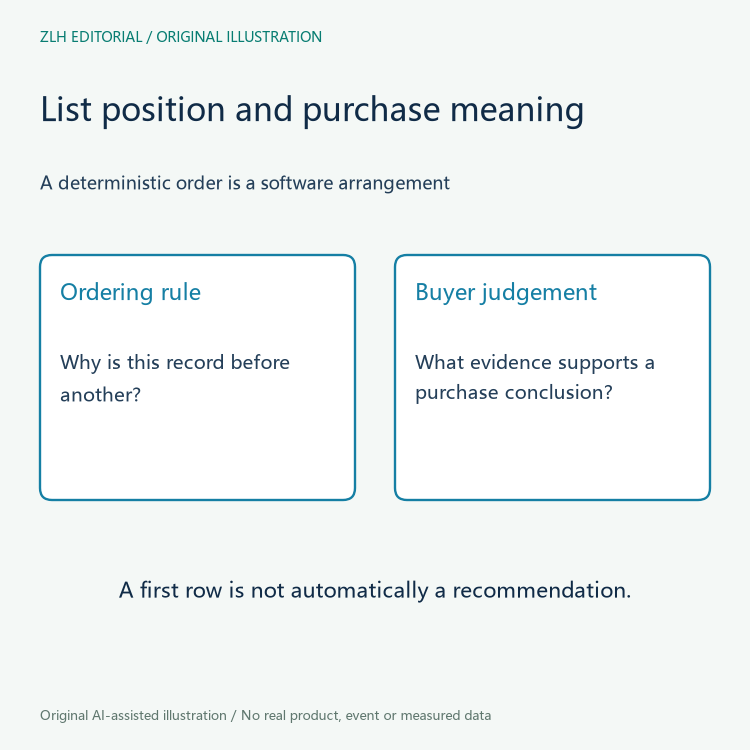
Describe position changes as bounded observations
A handover note should include the selected copy, filters, complete order expression, final-key decision and text comparison rule. If records move between observations, compare those inputs before attributing the movement to a business event. Retain unresolved differences instead of presenting an unexplained order as an audited ranking.
After an ordering change, ask a second reviewer to reproduce the sequence on the same authorized copy. Record the actual result only if that review occurs. This article proposes the procedure without inventing a query output or claiming a marketplace has adopted it.
Compare repeated review exports by stable record identity before comparing row positions. If a record is missing from one export, establish whether it was excluded by a filter or absent from the selected copy. If it is present in both, compare the documented ordering fields and rules. Keep these as separate observations rather than labelling every position change an update to the listing. An export can preserve an ordered sequence while omitting the query that created it, so request that query context before calling the comparison reproducible.
The original illustrations contain no sellers, prices or purchase recommendations. Continue with the robot marketplace record collection and article directory for related methods. A clearly defined review order makes software behavior easier to discuss while preserving the separate question of what a buyer should conclude about a robot.


